
…..
How a tiny, spotted insect is helping farmers in Pakistan’s Balochistan province fight back against pests, without a single drop of chemical pesticide.
Nehmatullah, a farmer from Balochistan, had seen the signs before: curling leaves, sticky residue and yellowing plants. Aphids, whiteflies and spider mites have long threatened vegetable farms across Bostan Pishin district. For years, the response was familiar: reach for the pesticide sprayer.
“We used chemicals because that’s what we knew,” said Nehmatullah. “Sometimes it worked. But every year we needed more, and the soil felt different, less alive.”
Heavy reliance on synthetic pesticides can lead to resistance among pests, environmental contamination, declining soil health and harm to beneficial organisms. As pests become harder to control, farmers often find themselves spraying more frequently, with diminishing results.
In Balochistan, researchers are testing a natural alternative: using ladybird beetles to control destructive agricultural pests and reduce farmers’ dependence on chemical pesticides.
Bringing in the beetles
At the Balochistan University of Information Technology, Engineering and Management Sciences (BUITEMS) in Quetta, researchers launched an initiative to breed thousands of seven-spotted ladybird beetles (Coccinella septempunctata).
The initiative, led by the International Water Management Institute (IWMI) in collaboration with BUITEMS, aimed to determine whether restoring a natural predator could help control pests without compromising crop yields.
Ladybird beetles are natural predators of aphids, whiteflies and spider mites. Under the supervision of BUITEMS lecturer Salman Aziz and assistant professor Imran Ali Sani, two master’s students from the agriculture college undertook the task of rearing the insects from eggs to adulthood.
The process required carefully controlled conditions. Since ladybird larvae can cannibalize one another under stress, the team maintained temperatures around 25°C, humidity levels between 60% and 70%, and a daily cycle of 16 hours of light and eight hours of darkness.
The effort produced more than 3,000 adult beetles, providing enough insects to move the experiment from the laboratory to an actual farm.
From the laboratory to the field
The field trial took place at a tomato farm in Bostan Pishin, where the beetles were released onto plants affected by heavy pest infestations.
For farmers accustomed to chemical spraying, relying on insects to protect their crops was an unfamiliar approach. However, the results were encouraging.
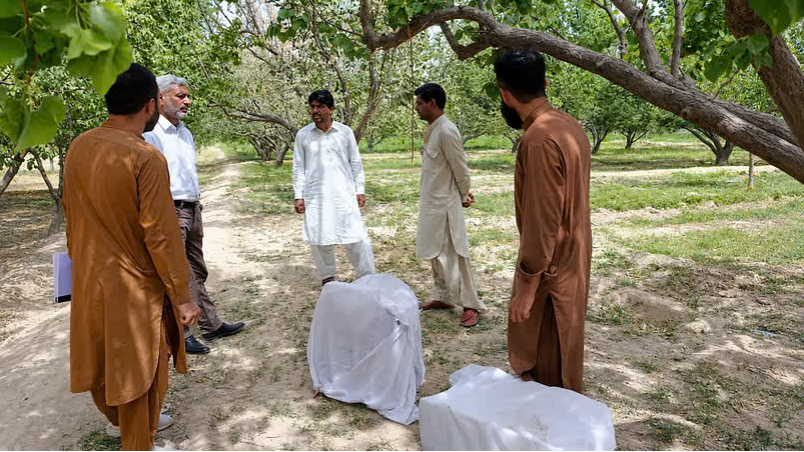
Within weeks, farmer estimates indicated that aphid populations had declined by approximately 47%, spider mites by 46% and whiteflies by 16%. As pest pressure decreased, tomato yields increased by as much as 20%.
“I didn’t think insects could do what chemicals do. But the plants recovered, and we didn’t spend money on sprays that season,” said Bakhtiar Khan, a tomato farmer in Bostan Pishin.
The trial demonstrated the potential of biological pest control to reduce chemical use while protecting agricultural productivity. It also offered farmers an alternative that avoids pesticide residues and the recurring costs associated with repeated spraying.
Why biological pest control matters
The results have implications beyond a single tomato farm. Biological control is an important component of Integrated Pest Management (IPM), an approach that combines different methods to manage pests while minimizing risks to human health and the environment.
For Balochistan, where agriculture already faces water scarcity, climate pressures and fragile natural resources, low-cost and environmentally friendly pest management methods could offer significant benefits.
Reducing dependence on chemical pesticides can help protect soil ecosystems and beneficial insects while supporting more resilient farming practices.
The initiative also provided an opportunity to introduce farmers to climate-smart agriculture and the importance of maintaining ecological balance in agricultural systems. Rather than relying exclusively on chemical inputs, farmers can benefit from approaches that work with natural processes.
The road ahead
Despite promising results, the initiative faced challenges. Limited awareness of biological pest control among farmers and security constraints that complicated field monitoring in parts of Balochistan affected the project’s reach.
Researchers are now looking to expand field trials to additional areas, strengthen farmer training and establish local beetle-rearing facilities. These efforts could ensure a more consistent supply of beneficial insects and help farmers adopt biological pest management on a larger scale.
For tomato farmer Bakhtiar Khan, the experience has changed how he thinks about pest control.
“If the beetles keep working like this, I don’t need to go back to spraying,” he says. “That’s better for my field and better for my family.”
In the pest-pressured fields of Bostan Pishin, a small beetle is demonstrating how nature-based solutions can help farmers protect their crops, reduce production costs and move towards more sustainable agriculture.
IWMI Editor’s Note: This blog is based on findings from a study conducted by IWMI and its partners. The study has not yet been published and is expected to be released later this year.
This story was picked from IWMI website: