…..
For decades, Pakistan’s human rights and development sectors faced a persistent legislative gap: the lack of formal personal law recognition for the indigenous Kalash community. Residing in the enclave valleys of Lower Chitral—Bumburet, Rumbur, and Birir—the Kalash population (numbering just over 4,000) navigated family life, marriages, and inheritances purely through uncodified oral traditions and local Qazi councils.
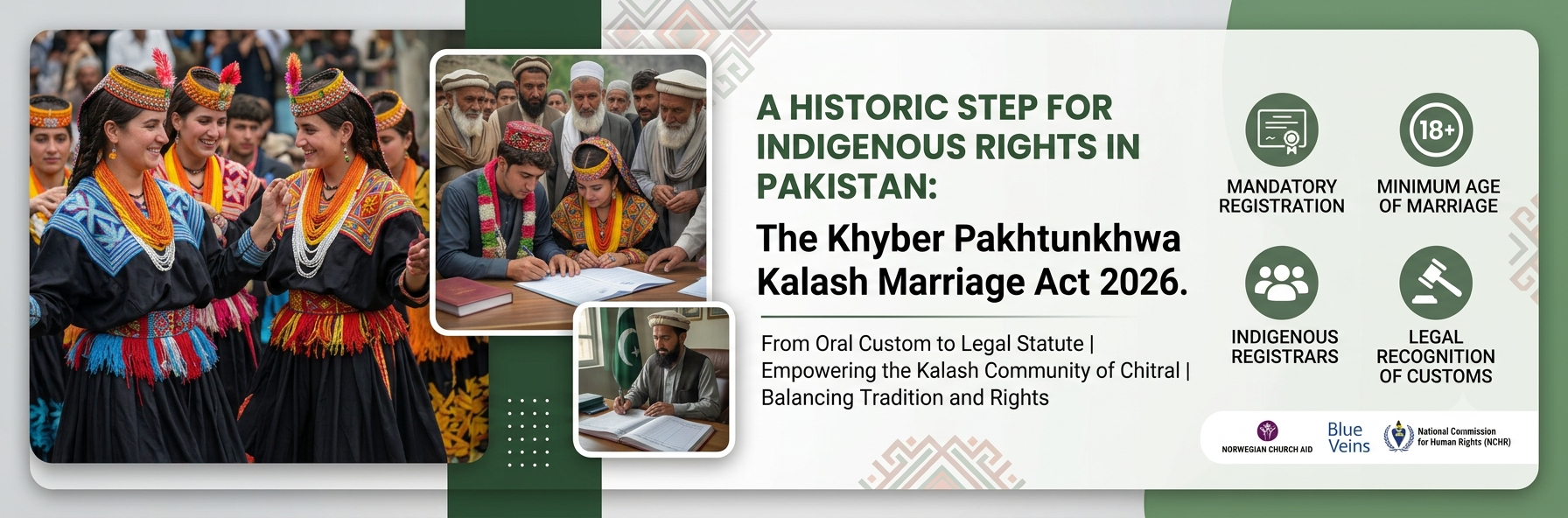
The recent passage of the Khyber Pakhtunkhwa Kalash Marriage Act, 2026 by the KP Assembly marks a historic triumph for rights-based legal reform. It represents Pakistan’s first dedicated personal law framework for an indigenous minority, offering a compelling case study in effective state–civil society partnership.
The Civil Society Blueprint: Driving the Legislative Journey
The passage of this law was not an accidental policy outcome; it was the product of structured, multi-year advocacy, baseline research, and legislative drafting led by non-governmental organizations.
- Norwegian Church Aid (NCA): Under its flagship “Faith in Action for Equal Rights and Opportunities” program, NCA provided institutional backing, strategic direction, and funding. NCA’s long-term commitment to social cohesion and minority inclusion in KP established the enabling environment for high-level legislative engagement.
- Blue Veins & Faith Friends: Serving as the lead local drafting and civil society partners, Blue Veins (led by Program Manager Qamar Naseem) facilitated years of grassroots consultations. They worked across political party lines and civil administration to draft a text that aligned local customs with statutory principles.
- National Commission for Human Rights (NCHR): The NCHR provided critical statutory backing, evaluating draft iterations against Pakistan’s international treaty obligations (ICCPR, ICERD) and constitutional rights guarantees.
- Community Leadership: The initiative was championed inside the political machinery by Wazirzada (KP’s first Kalash MPA and CM Focal Person on Minority Affairs) alongside local Qazis (traditional spiritual judges) and community youth advocates who validated the codification process.
Key Provisions: A Synthesis for Policy Analysts
The Act successfully harmonizes statutory rights with centuries-old customary law without eroding indigenous autonomy:
| Legislative Area | Codified Provision under 2026 Act | Practical Impact |
| Legal Status & Verification | Mandatory civil registration via Marriage Registrars appointed at Village/Neighbourhood Council levels. | Resolves long-standing documentation barriers for CNICs, passports, and civil records. |
| Consent & Protection | Minimum age fixed at 18 years; free consent and sound mental health made statutory prerequisites. | Direct legal protection against premature unions and forced marriages. |
| Cultural Codification | Formal recognition of customary rites like Shisha-Istongas (cleansing rituals) and Alashing marriages. | Protects indigenous practices from legal challenges in Family Courts. |
| Lineage Rules | Legal recognition of customary prohibitions against marriages within seven generations of paternal lineage. | Validates local endogamy customs into codified statutory law. |
| Dissolution & Maintenance | Customary Ja Jhutik (divorce by husband) and Ja-Parik (wife choosing separation) formalised. | Establishes clear financial and custody rules without forcing non-indigenous procedures. |
Implications for Development & Rights Practitioners
For the donor community, INGOs, and local civil society in Pakistan, this legislative milestone offers several strategic takeaways:
- A Model for Participatory Lawmaking: Rather than imposing top-down legal frameworks, the drafting process prioritized grassroots buy-in from local Qazis and women’s assemblies, proving that traditional structures can co-exist with formal statutory law.
- Beyond Token Inclusion: The law creates actual administrative machinery (local registrars, village-level registers, Family Court jurisdiction) that requires ongoing monitoring, civil society capacity building, and community awareness.
- Synergy with Global Heritage Frameworks: With the Kalasha Valleys under consideration for UNESCO World Heritage designation, this Act establishes an essential legal safeguard for living intangible heritage.
What’s Next? The Implementation Agenda
A law is only as strong as its administrative rollout. In the coming 120-day implementation phase, development partners and civil society must focus on three operational priorities:
- Capacity Building for Local Registrars: Training Village Council secretaries and designated Kalash marriage registrars on record-keeping and data privacy.
- Legal Literacy Campaigns: Conducting community awareness sessions in Lower Chitral to ensure families understand their statutory rights regarding registration, dowry, and dissolution.
- Monitoring & Judicial Sensitization: Briefing district judges and Family Court officers in Lower Chitral on interpreting customary provisions under the new Act.
“This legislation sets a vital precedent for how Pakistan can safeguard its vulnerable indigenous groups. It proves that when INGOs, local advocacy groups, and state institutions align around community trust, lasting policy reform is entirely achievable.”