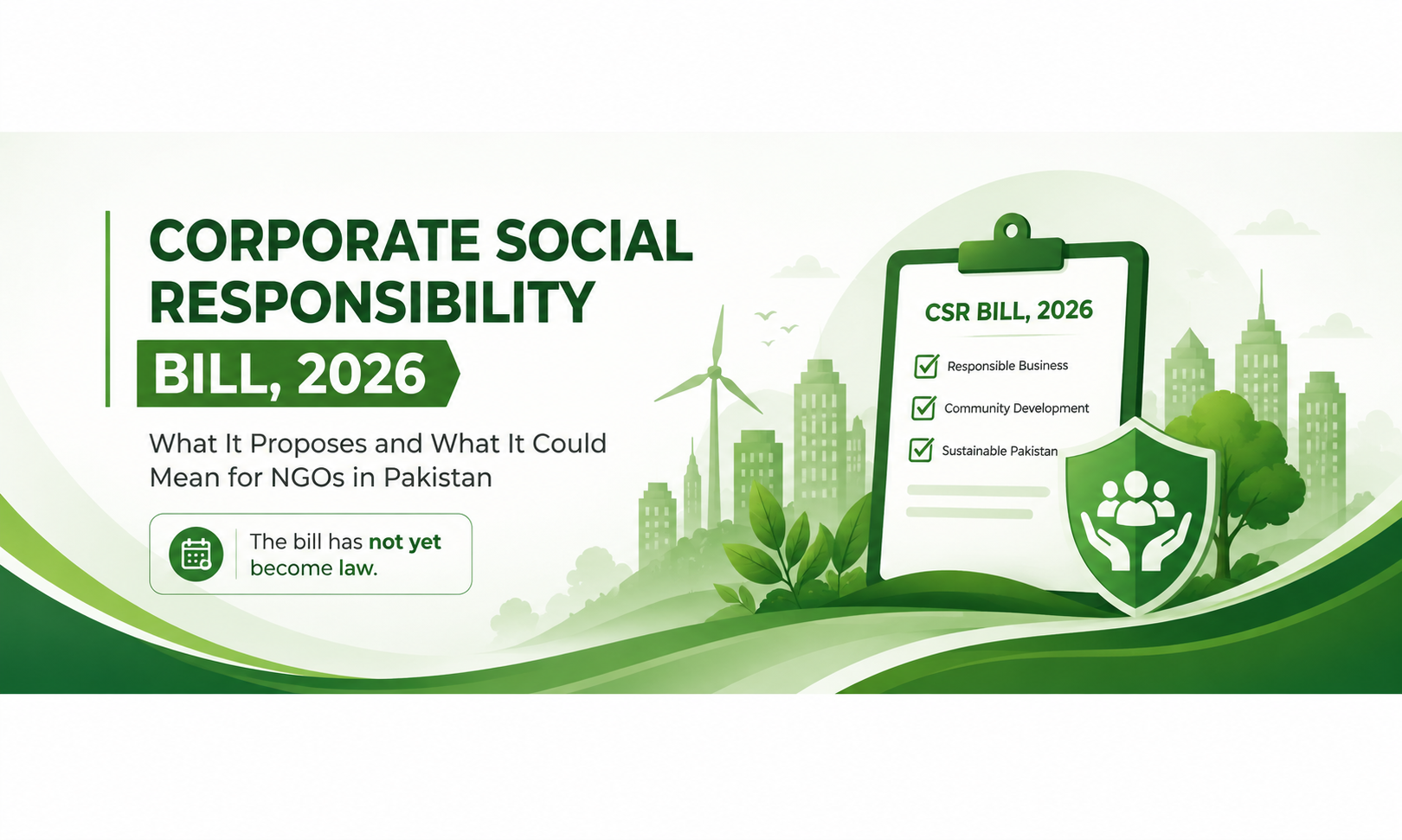
Disclaimer: As of the date of publication, the Corporate Social Responsibility (CSR) Bill, 2026 has not yet become law.
Corporate Social Responsibility (CSR) has traditionally been a voluntary practice in Pakistan, with many companies supporting charitable causes, community development, environmental protection, education, and healthcare initiatives. The Corporate Social Responsibility Bill, 2026 seeks to introduce a more structured framework by requiring certain profit-making companies to formally plan, implement, and report their CSR activities.
Although the bill has not yet become law, it is an important development that NGOs and other development organizations should keep on their radar.
What Does the CSR Bill Propose?
The proposed legislation aims to establish a legal framework for CSR in Pakistan by placing greater responsibility on eligible companies to contribute to social and environmental development. Some of its key features include:
- Mandatory CSR Policy: Covered companies would be required to adopt a Corporate Social Responsibility Policy approved by their Board of Directors.
- Board Oversight: Company boards would oversee CSR planning and implementation, making CSR part of corporate governance rather than a voluntary public relations activity.
- Annual Reporting: Companies would disclose their CSR initiatives in their annual reports, promoting greater transparency and accountability.
- Recognized CSR Activities: The bill identifies several areas that may qualify as CSR, including education, healthcare, environmental protection, disaster response, community development, women’s empowerment, vocational training, research, and other public welfare initiatives.
- Regulatory Oversight: The Securities and Exchange Commission of Pakistan (SECP) would be responsible for issuing regulations to guide implementation and reporting.
Importantly, the bill regulates eligible profit-making companies, not NGOs. However, if enacted, it could significantly influence how companies engage with civil society organizations.
What Could CSR Bill Mean for NGOs?
While the bill does not impose any legal obligations on NGOs, it could create new opportunities for organizations working in Pakistan’s development sector.
More Corporate Partnerships
Many companies lack the expertise and local presence needed to implement community development projects themselves. NGOs with experience in education, health, livelihoods, climate change, humanitarian response, disability inclusion, women’s empowerment, or community development may become attractive partners for corporate CSR programmes.
Diversified Funding Opportunities
Many NGOs in Pakistan rely heavily on international donors, UN agencies, and bilateral development partners. A stronger CSR framework could encourage more companies to invest in development initiatives, providing NGOs with an additional domestic funding source.
Greater Emphasis on Accountability
As companies become more accountable for their CSR investments, they are likely to seek partners with strong governance systems. NGOs may increasingly be expected to demonstrate:
- Transparent financial management
- Audited financial statements
- Effective monitoring and evaluation systems
- Clear evidence of project impact
Organizations with strong compliance and reporting systems could be better positioned to secure corporate partnerships.
How NGOs Can Prepare
Even before the bill becomes law, NGOs can take practical steps to prepare for future corporate partnerships:
- Strengthen governance and financial management systems.
- Keep audited financial statements up to date.
- Document project results and impact with reliable data.
- Develop clear organizational profiles and partnership materials.
- Build relationships with companies that have active CSR programmes.
These measures will not only improve readiness for future CSR opportunities but also strengthen organizational credibility with donors and other stakeholders.
The Corporate Social Responsibility Bill, 2026 signals a growing policy interest in encouraging greater private-sector participation in Pakistan’s social and environmental development. Although the bill has not yet become law, it highlights the potential for stronger collaboration between businesses and civil society organizations.
For NGOs, this is a good time to prepare rather than wait. Organizations that demonstrate transparency, accountability, and measurable impact are likely to be well placed if the proposed legislation is enacted and companies begin expanding their CSR investments.