…..
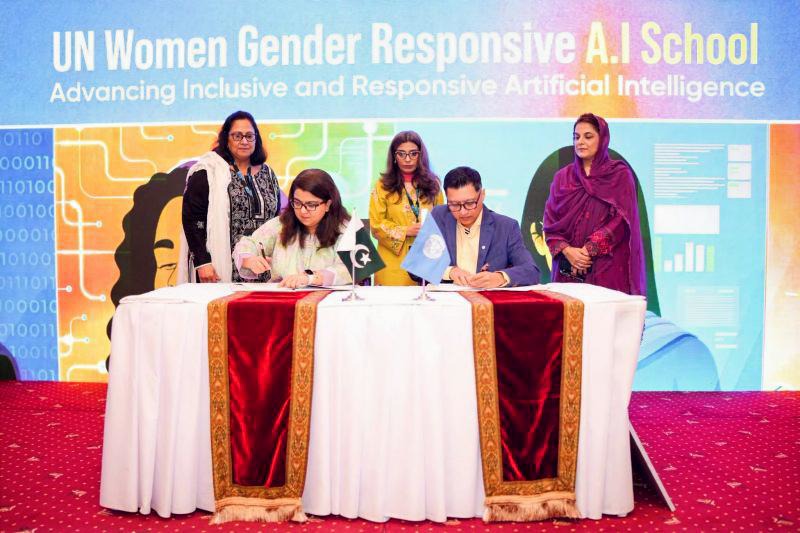
As artificial intelligence (AI) increasingly shapes public services, governance and economic development, Pakistan has taken an important step towards ensuring that these technologies are designed and deployed responsibly.
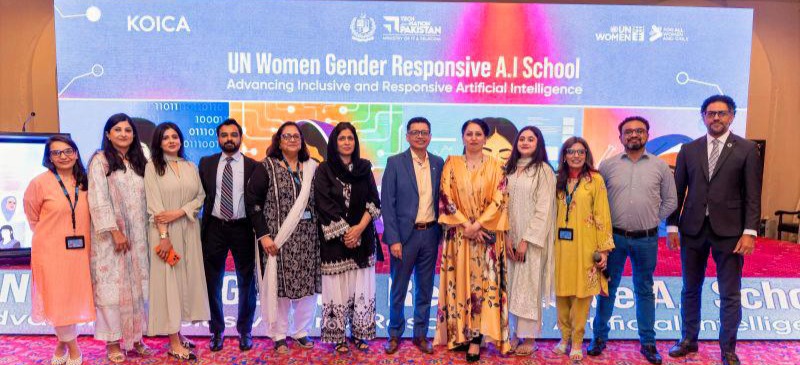
The Ministry of Information Technology and Telecommunication (MoITT), in collaboration with UN Women Pakistan and with support from the Korea International Cooperation Agency (KOICA), has officially launched the UN Women Gender-Responsive AI School Pakistan. The initiative seeks to strengthen AI literacy while ensuring that gender equality, ethics and inclusion remain central to Pakistan’s digital transformation.
For NGOs, INGOs, academia and public institutions working at the intersection of technology, governance and social development, the programme represents an opportunity to build capacity on one of the fastest-evolving policy areas in the world.
Why Gender-Responsive AI Matters
Artificial intelligence systems are only as fair as the data and assumptions behind them. Around the world, researchers have highlighted how AI can unintentionally reinforce existing social inequalities when training data underrepresents women or marginalized communities.
A gender-responsive approach aims to reduce these biases by ensuring that AI systems are designed, governed and evaluated with fairness, transparency and inclusion in mind. Rather than treating gender as an afterthought, it embeds equality considerations throughout the AI lifecycle—from data collection and model development to deployment and oversight.
For Pakistan, where digital services are expanding rapidly across government, education and development programmes, this approach has growing relevance.
Building National Capacity
The initiative has already begun through a Training of Trainers programme that brought together participants from government institutions, parliament, academia, civil society and development organizations. These trainers are expected to support wider dissemination of gender-responsive AI knowledge within their respective institutions and networks.
The curriculum focuses on practical AI literacy alongside responsible AI governance, ethical use of emerging technologies and the integration of gender perspectives into policymaking and institutional practice. According to UN Women, participants also explore real-world applications of AI for sustainable development and public service delivery.
Government and Development Partners Back the Initiative
Federal Minister for Information Technology and Telecommunication Shaza Fatima Khawaja has repeatedly emphasized that Pakistan’s digital transformation must be inclusive and that women should participate not only as users of technology but also as innovators, developers and decision-makers.
UN Women Pakistan Country Representative Jamshed M. Kazi described the initiative as an investment in leadership, institutional capacity and the skills required to build an inclusive AI future. Meanwhile, KOICA’s support reflects the growing interest of international development partners in responsible AI and digital inclusion.
What It Means for Pakistan’s Development Sector
For NGOs and development practitioners, artificial intelligence is no longer a futuristic concept. It is already influencing humanitarian response, research, monitoring and evaluation, communications, education, health services and programme management.
However, many organizations continue to face questions such as:
- How can AI be used responsibly?
- How do organizations protect personal data?
- How can bias be identified and reduced?
- What governance mechanisms should be in place before adopting AI tools?
Initiatives like the Gender-Responsive AI School help address these questions by combining technical knowledge with ethical and policy considerations. This is particularly valuable for organizations implementing donor-funded projects, where responsible data management and safeguarding are becoming increasingly important.
A Step Towards Inclusive Digital Transformation
Pakistan has recently accelerated several national initiatives related to artificial intelligence, digital governance and digital skills development. The launch of the Gender-Responsive AI School complements these broader efforts by ensuring that inclusion and gender equality remain part of the country’s AI journey rather than being addressed later.
As AI becomes more deeply integrated into development programming and public administration, initiatives that build ethical leadership and responsible governance will become increasingly important.
For Pakistan’s NGO community, this programme signals that AI is not solely a technology issue—it is also a governance, inclusion and development issue.