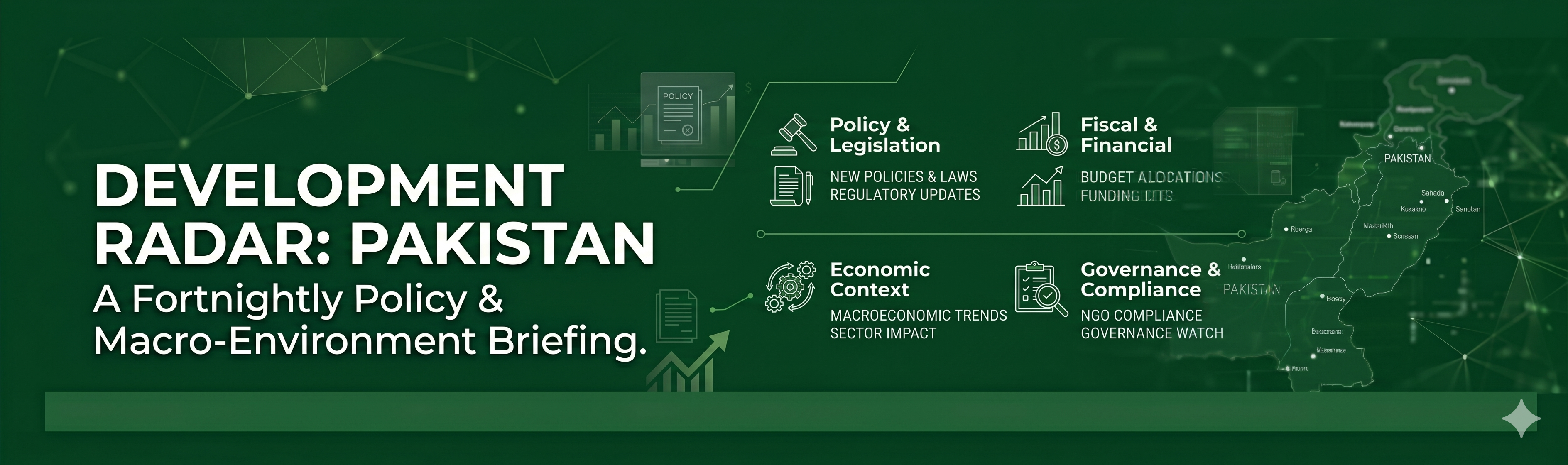
The Development Radar: Pakistan
A Fortnightly Briefing on Policy, Finance & Governance
Issue 01 | 9 June 2026
Tracking the policy, fiscal, and governance shifts shaping Pakistan’s development landscape.
At a Glance
- Federal development spending squeezed despite record project requirements.
- Government approves a proposed national development outlay of Rs4.715 trillion for FY2026-27.
- Water and hydropower projects face funding constraints amid climate and water security challenges.
- Provincial development programmes remain central to future public investment.
- Pakistan seeks greater investment in infrastructure and maritime development.
1. Development Spending Under Pressure Despite Record Demand
Pakistan’s development planners are entering FY2026-27 with a familiar challenge: ambitious development needs and limited fiscal space. The proposed federal Public Sector Development Programme (PSDP) allocation stands at Rs1.126 trillion, while funding requirements submitted by ministries exceed Rs4 trillion. Planning officials have warned that the growing stock of ongoing projects and unfunded commitments is becoming increasingly difficult to manage.
Why it matters
- Ongoing projects may face slower implementation.
- New development initiatives will face tougher scrutiny.
- Competition for public funding is likely to increase across sectors.
Read More
- Dawn: Budget 2026-27: IMF-mandated curbs squeeze development spending
https://www.dawn.com/news/2004536 - Planning Commission PSDP Portal
https://pc.gov.pk/web/psdp
2. Pakistan Sets a Record National Development Outlay
The Annual Plan Coordination Committee (APCC) has recommended a national development outlay of Rs4.715 trillion for FY2026-27. The proposed package includes federal PSDP spending, provincial Annual Development Programmes (ADPs), and investments by state-owned enterprises. The government has also adopted a 4 percent economic growth target for the upcoming fiscal year.
Why it matters
- Provincial governments will continue to drive the majority of development spending.
- Public investment remains a key tool for economic growth and job creation.
- The final budget will determine whether these ambitions are fully financed.
Read More
- The Nation: APCC recommends record Rs4.715 trillion uplift outlay, 4pc growth target
https://www.nation.com.pk/02-Jun-2026/apcc-recommends-record-rs4-715tr-uplift-outlay-4pc-growth-target-fy2026-27 - The News: APCC proposes Rs4.7tr uplift outlay
https://www.thenews.pk/print/1418457-apcc-proposes-rs4-7truplift-outlay - Profit Pakistan Today: National development outlay may exceed Rs4 trillion in FY2026-27
https://profit.pakistantoday.com.pk/2026/06/01/national-development-outlay-may-exceed-rupee4-trillion-in-fy2026-27
3. Water Security Projects Face Funding Constraints
Water and hydropower projects remain among Pakistan’s highest development priorities, yet available funding continues to lag behind requirements. Reports indicate that around Rs179 billion has been earmarked for 44 water-sector and hydropower schemes under the upcoming PSDP, reflecting efforts to prioritize ongoing projects amid fiscal constraints.
Why it matters
- Water security remains one of Pakistan’s most pressing development challenges.
- Climate adaptation and resilience investments depend heavily on these projects.
- Delays can affect agriculture, livelihoods, energy generation, and disaster preparedness.
Read More
- Business Recorder: PSDP 2026-27: Rs179bn earmarked for 44 water schemes, hydropower projects
https://www.brecorder.com/news/40424102/psdp-2026-27-rs179bn-earmarked-for-44-water-schemes-hydropower-projects - Planning Commission Press Releases
https://pc.gov.pk/web/press/get_all
4. Provincial Development Programmes Become Increasingly Important
While attention often focuses on the federal PSDP, provinces are expected to account for the largest share of public development spending. Proposed provincial development budgets total approximately Rs3.138 trillion, nearly three times the size of the federal PSDP allocation.
Why it matters
- Many education, health, local government, and social sector investments are financed provincially.
- NGOs and development partners should pay close attention to provincial budget announcements.
- Provincial priorities will shape development outcomes across communities.
Read More
- Business Recorder Budget Live Coverage
https://www.brecorder.com/live/budget-2026-27 - The Nation: APCC recommends record Rs4.715 trillion uplift outlay
https://www.nation.com.pk/02-Jun-2026/apcc-recommends-record-rs4-715tr-uplift-outlay-4pc-growth-target-fy2026-27
5. Infrastructure Investment Remains a Core Government Strategy
The government continues to seek external investment for large-scale infrastructure projects. Recent engagements with Saudi investors have focused on transport corridors, logistics, and strategic infrastructure, highlighting Islamabad’s emphasis on investment-led growth.
Why it matters
- Infrastructure projects can create employment and improve connectivity.
- Public-private partnerships are becoming increasingly important.
- Development actors should monitor how investment priorities align with social and environmental safeguards.
Read More
- Dawn: Pakistan pitches motorways to Saudi investors
https://www.dawn.com/news/2005550
6. Maritime Development Emerges as a New Policy Focus
Pakistan has signed a memorandum of understanding with Saudi and local partners to explore the development of a maritime business district on Karachi Port Trust land. The initiative reflects growing government interest in the blue economy, ports, logistics, and coastal development.
Why it matters
- New opportunities may emerge in urban development and logistics.
- Coastal communities could benefit from future investment.
- Maritime development is becoming a more visible component of Pakistan’s economic strategy.
Read More
- Radio Pakistan: Pakistan signs MoU to explore development of maritime business district
https://www.radio.gov.pk/07-06-2026/pakistan-signs-mou-to-explore-development-of-maritime-business-district - Enterprise AM: Saudi and Pakistani partners eye Karachi waterfront development
https://enterpriseam.com/ksa/2026/06/07/saudi-and-pakistani-partners-eye-140-acre-karachi-waterfront-development/
Radar Watch
Federal Budget 2026-27
The final budget announcement will determine actual allocations for health, education, climate resilience, social protection, and infrastructure programmes.
Provincial Budgets
Provincial ADPs will reveal local development priorities and funding opportunities.
PSDP Rationalization
Government efforts to reduce the backlog of ongoing projects may reshape future investment patterns.
Climate and Water Financing
Future funding decisions will indicate the government’s commitment to resilience and adaptation initiatives.
Foreign Investment Agreements
Watch for new announcements related to infrastructure, logistics, maritime development, and economic cooperation.
Bottom Line
The defining development story of the fortnight is the widening gap between Pakistan’s development ambitions and available fiscal resources. While policymakers continue to pursue large-scale investment and growth objectives, difficult funding choices are emerging across sectors. For NGOs, donors, researchers, and development practitioners, the upcoming budget cycle will provide the clearest indication yet of where public investment priorities are heading in FY2026-27.