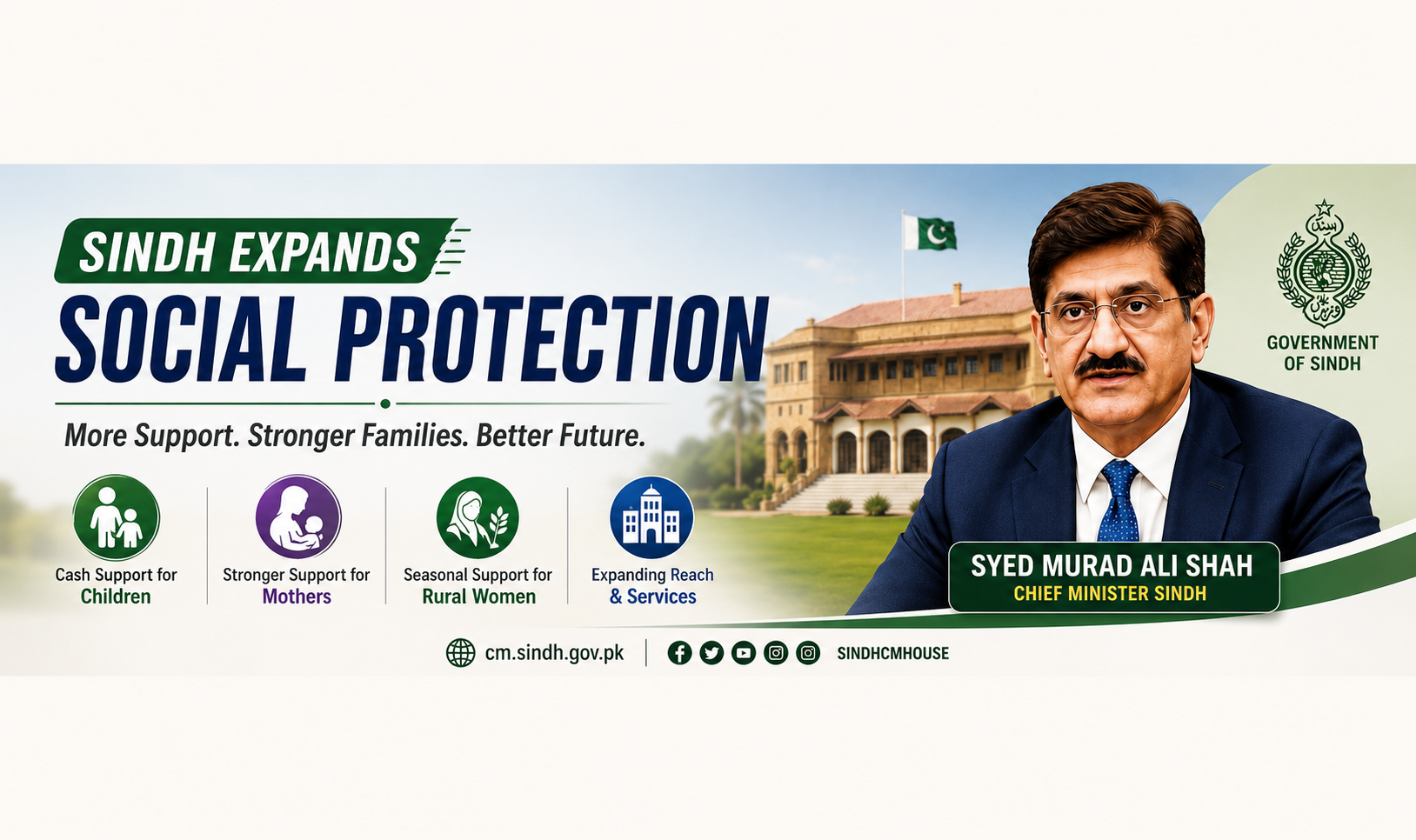
The Government of Sindh has approved a major expansion of its social protection system, introducing new cash support programmes for young children, pregnant and lactating women, and vulnerable rural women agricultural workers. The decisions were taken during the third Board Meeting of the Sindh Social Protection Authority (SSPA), chaired by Chief Minister Syed Murad Ali Shah.
According to official announcements, the province has approved a new Early Childhood Development (ECD) programme for 885,000 children, reforms to the Mamta maternal health programme, and seasonal income support for women agricultural workers. Together, these initiatives represent one of the largest recent investments in social protection and human development in Sindh.
A Rs. 14 Billion Investment in Early Childhood Development
The centrepiece of the new package is a Rs. 14 billion Early Childhood Development (ECD) programme that will support approximately 885,000 children from birth to five years of age.
Under the initiative, eligible caregivers will receive Rs. 3,000 every quarter. However, the programme is not merely a cash transfer scheme. The financial assistance is linked to child growth monitoring, nutrition counselling, and school readiness activities designed to improve long-term developmental outcomes.
Development experts have long argued that investments during the first five years of life generate some of the highest returns in terms of health, education, and future productivity. By combining cash support with child development interventions, the Sindh government is attempting to address both immediate poverty and longer-term human capital development.
Sources:
- https://tribune.com.pk/story/2606736/cm-expands-social-safety-net
- https://www.dawn.com/news/1998187/sindh-to-provide-cash-assistance-to-caregivers-of-children-up-to-five
Mamta Programme Expanded and Strengthened
The Board also approved important reforms to the Mamta Programme, Sindh’s flagship maternal and child health cash transfer initiative.
Currently operating in 22 districts with a reported budget of Rs. 56 billion, the programme serves more than one million registered beneficiaries. The newly approved reforms aim to make payments more predictable and reduce financial uncertainty for low-income households.
A Hybrid Predictable Payment Model (PPM) has been introduced, allowing beneficiaries to receive scheduled payments even when health visits are delayed. The Board also approved full cash transfers for pregnancy or the youngest child, while households with older children under the age of two will receive 75 percent of the standard transfer amount.
These changes are expected to improve programme coverage while ensuring that vulnerable children continue to receive support during critical developmental stages.
Sources:
- https://tribune.com.pk/story/2606736/cm-expands-social-safety-net
- https://www.thenews.pk/print/1414170-sindh-expands-social-safety-net-with-cash-support-for-mothers-rural-women
Seasonal Cash Support for Women Agricultural Workers
Another significant announcement is the introduction of a seasonal cash support programme for women agricultural workers.
Many rural women rely on seasonal agricultural labour and experience periods of unemployment or reduced earnings during lean farming seasons. To address this challenge, the Sindh government has approved monthly cash transfers during these low-income periods, typically lasting between two and four months each year.
The programme is expected to help women cope with seasonal income shocks, reduce dependence on debt, and improve food security within farming households.
From a development perspective, this initiative is particularly noteworthy because it addresses seasonal poverty rather than only chronic poverty. Such approaches are increasingly being used globally to help vulnerable households build resilience against economic shocks and climate-related risks.
Sources:
- https://english.sunonews.tv/pakistan/social-issues/sindh-government-unveils-rs3000-child-stipend-for-rural-families/1778126986-16191
- https://www.brecorder.com/news/amp/40419949
Expanding Social Protection Beyond Rural Areas
The Sindh government has also approved feasibility studies for expanding social protection services into underserved urban areas of Karachi and Hyderabad.
The studies are reportedly being conducted in collaboration with the Gates Foundation and will assess how existing programmes can be extended to vulnerable urban populations. The Board additionally approved measures to integrate health department facilities in seven newly selected districts into the Mamta programme delivery system.
These decisions indicate a broader effort to build a more integrated and accessible social protection framework across the province.
Source:
Why This Matters for NGOs and Development Practitioners
The newly approved initiatives are significant because they focus on three groups that often face overlapping vulnerabilities:
- Young children during their most critical developmental years;
- Pregnant and lactating women;
- Rural women agricultural workers facing seasonal income insecurity.
For organizations working in nutrition, maternal and child health, education, livelihoods, food security, climate resilience, and women’s empowerment, these programmes could create new opportunities for partnership, beneficiary referrals, community outreach, research, and advocacy.
The initiatives also reflect a growing shift from standalone welfare programmes toward integrated social protection systems that combine financial assistance with health, nutrition, and human development services.
How Can Beneficiaries Apply?
At present, the Sindh government has announced the approval of these programmes, but detailed implementation guidelines have not yet been publicly released.
As of June 2026, there is no publicly available application portal or registration process specifically for the newly approved ECD programme or the seasonal support programme for women agricultural workers.
Potential beneficiaries should therefore be cautious about unofficial registration messages, forms, or agents claiming to offer enrolment services.
Individuals interested in these programmes are advised to:
- Follow announcements from the Sindh Social Protection Authority (SSPA);
- Contact their local district administration offices for updates;
- Consult local health facilities participating in the Mamta Programme;
- Monitor official Government of Sindh communication channels.
Until implementation details are released, no formal application process has been announced.
Official Resources
Sindh Social Protection Authority (SSPA):
https://sspa.gos.pk
Government of Sindh:
https://www.sindh.gov.pk
Chief Minister Sindh Office:
https://cm.sindh.gov.pk
Looking Ahead
The expansion of Sindh’s social protection system represents an important investment in the province’s future. By supporting young children, strengthening maternal health services, and assisting vulnerable rural women, the government is attempting to address some of the root causes of poverty and social exclusion.
The real test, however, will be implementation. The success of these initiatives will depend on transparent beneficiary selection, efficient payment systems, strong monitoring mechanisms, and effective coordination between government departments and development partners.
Pak NGOs will continue to monitor developments and share updates as further information on eligibility criteria, registration procedures, and programme rollout becomes available.